Howdy friends! Detour update. I took a fractional CTO engagement this summer and I want to tell you why and how it went.
The unglamorous why
I left Google to build RiseOhana, a family bonding app where parents create quests for their kids and everyone levels up together. I know that life and startups, nom nom money. I knew I had about ten months of road in front of me. I also had illusions of grandeur that with AI I would get there sooner than that. Alas, building a business is still crazy hard.
So the coffers got thin. Not “shut it all down” thin! More like “hey buddy, maybe do something about this before it becomes that” thin.
Every advisor I have talked to told me everything takes way longer than you think. They were right. The part nobody mentions is that “longer” is priced in dollars.
So I did the very founder thing. I went and got a job. Sort of. A fractional one.
What the fractional CTO engagement actually was
JENGAI. Recently funded, roughly 20 person team. They had been on AI coding tools for months before I showed up. Copilot, Cursor, Claude, the whole buffet.
Adoption? Fine on paper. Everybody had it open.
Velocity? Flat as a pancake.
Everyone assumes the AI problem at work is that nobody is using the tools. JENGAI was well past that. They adopted early, which already puts them ahead of most teams I talk to, so they got to the part nobody warns you about first.
Most of the team was working in ask mode. Type a question, read the answer, copy the snippet, paste it in, poke at it until it compiles. That is a perfectly sensible place to start! It is also autocomplete with extra steps. All of the volume, none of the leverage.
A few had gone full agent mode, handing over real tasks and letting it work across the codebase. Which is the right direction! It also generated the most cleanup, because an agent without guardrails gives you more of whatever you already had, faster.
This is not a story about a team doing it wrong. I did the exact same thing to my own codebase and then wrote a whole post about it. Plausible code that is subtly wrong, arriving faster than anyone can read it. Everybody I know who has picked up these tools has lived some version of this.
The system kept getting slower too. Not dramatically! Just a little slower every week, the way you gain weight. One core read had quietly drifted out to thirteen minutes. Thirteen! Nobody sits down and builds that on purpose. It accumulates.
That is not a tooling problem and it is not a people problem. It is a missing layer.
What I installed
I had a long runway with the JENGAI team, which meant I was not handing over a workflow and disappearing. I got to onboard them onto a full agentic development workflow, then stick around and watch it run. In their actual codebase, on an actual feature. Not slides! I cannot stress this enough. Nobody in the history of software has been made faster by slides.
That runway is what turned it into a repeatable pattern. Month after month I could see which parts were JENGAI specific and which parts would travel to any team. Twenty engineers using something every day will tell you very quickly which bits are annoying. Annoying is the stuff that quietly stops getting used.
The install itself is a week. The months that followed are how I know it stays installed.
- The Pipeline. Idea to spec to review to ship. One workflow every engineer runs on every feature.
- The Agents. Automated senior review that reads every pull request before a human has to.
- The Skills Library. Reusable AI skills for the stuff the team repeats every week, so it compounds instead of resetting every single prompt.
- The Ruleset. Their standards and taste, written down once, read by every AI tool they touch.
- The Docs. PRD, TDD and checklist templates that leave a real trail.
All of it committed straight into their repo. Version controlled, reviewable, theirs forever. I do not host it. I do not rent it back to them. It just lives there.
How it went
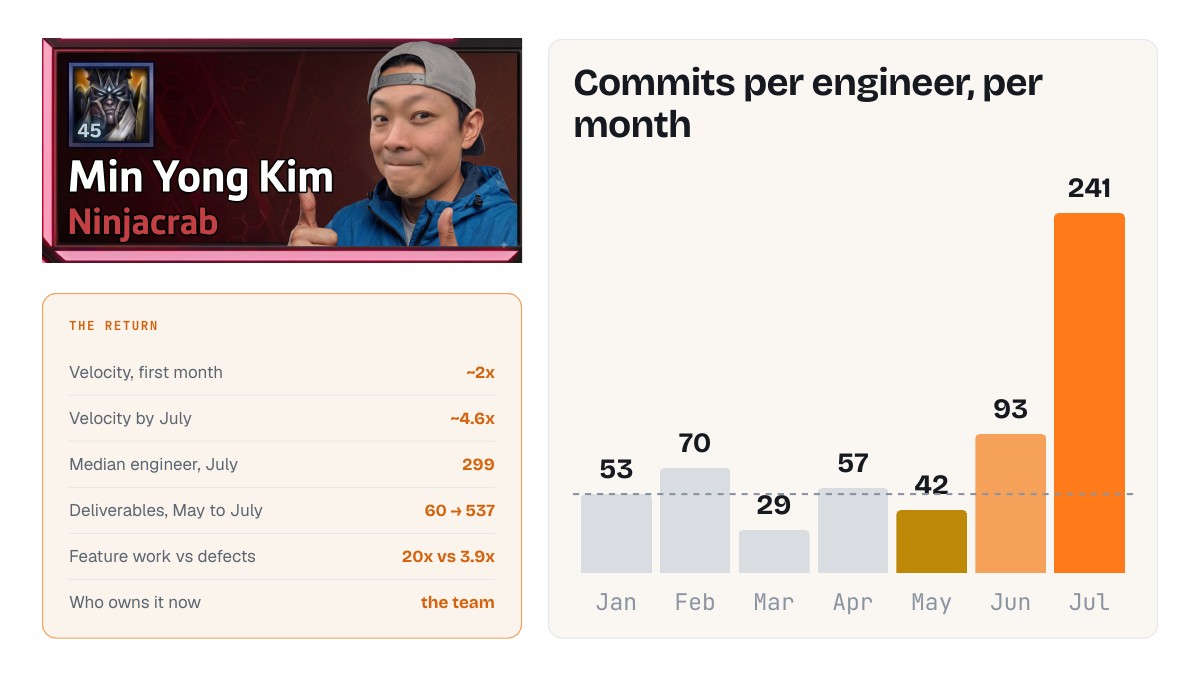
Okay so. Before I showed up the team averaged about 52 commits per engineer per month. In July they hit 241 as a mean. The median was 299.
Two hundred and ninety nine!
Now, whoaaaa there partner! You might want to call me out here and say commits are a garbage metric on their own. You would be right! Waving that number around without saying so would make me a hypocrite, because my whole method deliberately makes changes smaller. I cannot review four thousand lines. Neither can you. Neither can that very confident intern. A hundred lines? Sure! So of course the commit count went up. Some of that is just arithmetic wearing a party hat.
Here is the number that survives me poking at it. Deliverables shipped. Things that actually went out the door.
May: 60.
July: 537.
Bazinga!!! 10x baby!!!! Ok, maybe more 9ish, but still!!! Holy hand grenade Batman!
The one I care about most is the mix. Feature work grew about twentyfold. Defects grew less than fourfold. They did not just go faster, they went faster without the wheels flying off, which is the thing we are all quietly terrified of when we point AI at a codebase.
Every feature now carries a PRD, a technical design and a checklist. The checklist part sounds boring! It is the most important thing on the list. Checklists are where estimates come from. You cannot forecast work that nobody has broken down, which is why “it will take about two weeks” has been a lie in our industry since roughly forever.
The whole point
I stopped coding on it.
That was not an accident. It is the thing I have been doing my entire career. Make yourself unnecessary. Teach the people around you, find your successor, then go put your attention somewhere it is actually needed. Twenty eight years of that.
By July my own commit count on their codebase was basically zero. Twenty odd engineers were running the whole thing without me.
That is the number that matters. Not the 537. Not the 299. The zero.
Somewhere in the middle of all this I closed a live security exposure and root caused a production outage the team had been chasing in entirely the wrong direction. Neither was on the agenda. It never is.
What it did for RiseOhana
It bought runway. Not a refill, not a war chest. Runway! That was the entire point and it worked.
Now the part that stings. Every hour I spent in somebody else’s codebase was an hour I did not spend in mine. RiseOhana did not move much this summer. When you are already behind, choosing to fall further behind on purpose is a rotten trade, even when it is obviously the right one.
So here comes the small plug. I am doing this on purpose now, over at fractionalmin.com. Maybe your team has every AI tool on the shelf with flat velocity to show for it. Maybe you just want a senior brain on the calls you would rather not take alone. Either way, come say hello. Every engagement buys RiseOhana more road, so you would be helping two things at once.
What I actually learned
I built this method for me. It came straight out of the frustration I whined about right over here, where AI hands you plausible code that is subtly wrong and your job quietly shifts from writing to catching. So I built guardrails. Partly because I was getting burned, partly because this whole field is still brand new.
There is a difference between cutting edge and bleeding edge. For most people AI development is still firmly bleeding edge. You reach for it, it cuts you, you go looking for a bandage. The guardrails are what moved it to cutting edge for me. Still sharp! Just no longer bleeding.
Turns out the thing you build to survive your own problem is very often the thing other people will happily pay for. I did not set out to be a fractional CTO! I set out to keep the lights on.
I will admit this detour was a bit cathartic. It is nice to do something you are really good at and get rewarded for it right away. Building a startup does not work like that. You pour in a year and find out much later whether any of it landed.
It is not my life’s mission though. That is still serving families out in the world. This just bought me more time to go do it.
Also, here is the real ranking. Our first paying customer still means more to me than that invoice did. It is not close. It is not even in the same building.
Keep on coding on, friends!
RiseOhana is my startup, a family engagement platform where parents create quests, kids share their adventures and everyone levels up together through gamified parenting and quality time rewards. Built by a nerdy dad of three who spent 28 years helping machines communicate better and decided it was time to build something that helps families do the same. If that sounds like your jam, come find us at riseohana.com.
Leave a Reply
You must be logged in to post a comment.